
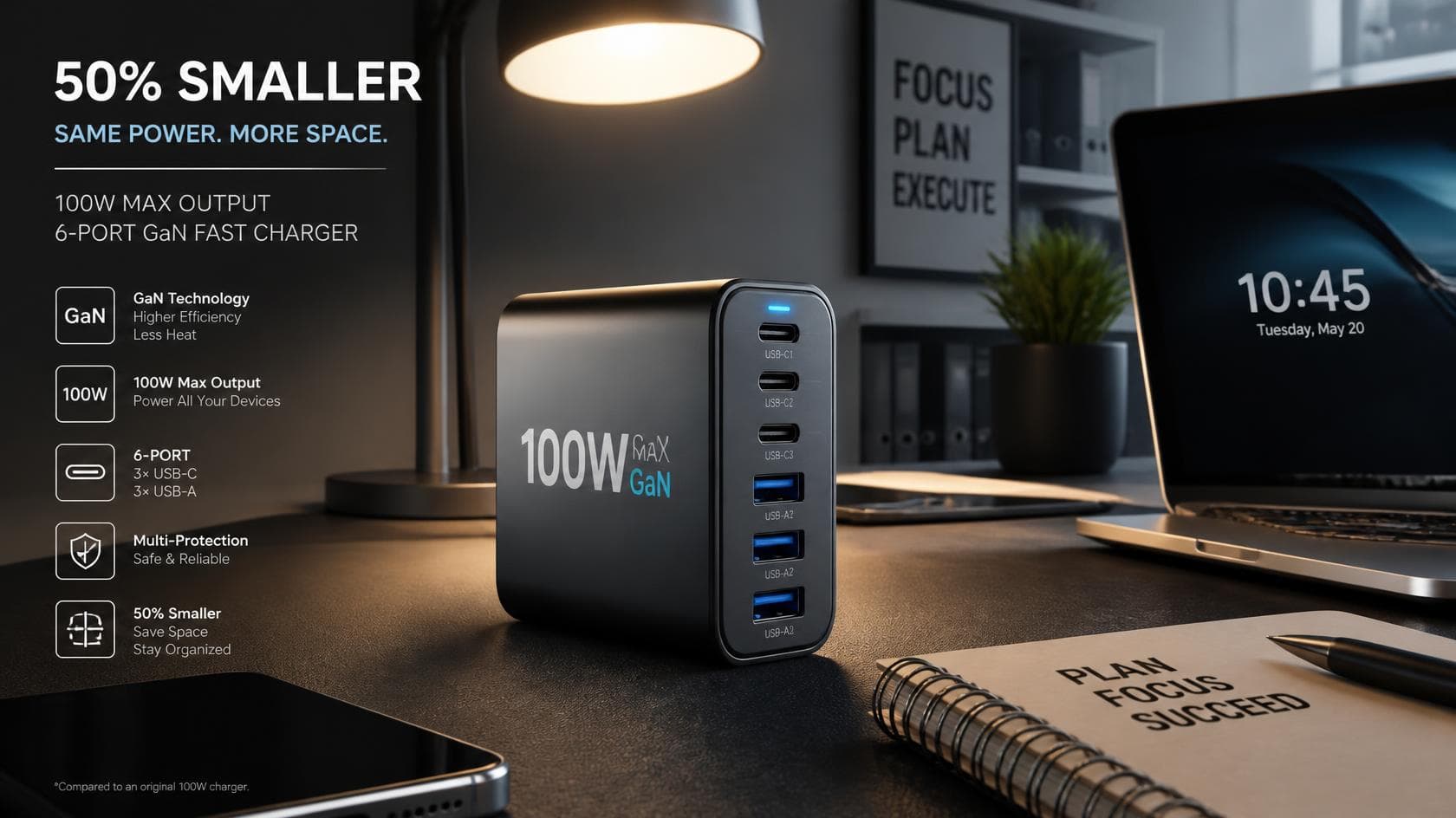
The 6-port GaN charging station presents itself as an effective phone/tablet charging hub, but it has some intrinsic complexities around its power output. Although marketed with the “100W” label, this specification refers to a 100W shared total output across all ports rather than from a single USB-C port, challenging its effectiveness as a dedicated laptop charger. The device features three USB-C PD ports capable of up to 20W each, and three USB-A ports providing up to 18W each, which makes it inadequate for charging laptops that often require higher wattage. Notably, popular models such as the MacBook Pro, Dell XPS series, Microsoft Surface Laptop, and many Lenovo ThinkPad models typically require higher power delivery, frequently requiring 60W or more from a single port. As a result, users with these or similar laptops will find this charger unsuitable for primary charging.
Overview and Use Case
This device is best suited for settings with numerous gadgets such as families, dormitories, or office desks—places where multiple phones, tablets, earbuds, and accessories are regularly in use. The total output is capped at 100W shared across its six ports, split between three USB-C PD 3.0 ports and three USB-A ports. This configuration accommodates devices with modest power needs but doesn’t extend to laptops that require a consistent 65W–100W from a single USB-C port.
The compact, GaN technology-based design is another notable feature, enabling efficient operation and a smaller footprint, making it suitable for desktops and travel. The combination of USB-C and USB-A connectors highlights utility for users juggling different device generations, eliminating the need for several chargers and adapters.
Limitations
The main limitation is the lack of a 100W USB-C port, which matters for several laptops and high-powered tablets that need robust charging; the collective 100W capacity is shared among connected devices, which can reduce charging performance when multiple gadgets are plugged in. Additionally, while it supports standard USB Power Delivery, it might not be compatible with certain proprietary fast-charging protocols used by some phone brands. For example, specific Samsung models using Super Fast Charging, OnePlus devices with Warp Charge, and some Xiaomi models may not achieve their maximum fast-charging speeds. As a result, users with these or similar devices could experience slower-than-expected charging times.
Considerations
Prospective buyers should watch for purchase pitfalls, incldifferentons in product versions that may affect plug type and voltage compatibility. Check essential safety certifications for your region, and ensure the package includes a compliant power cable and adapter set. Some users report common durability and performance issues, including rough extended use, intermittent or total failure, and charging speeds that slow significantly over time. Some buyers also mention slow overnight charging and long-term durability concerns, suggesting they review retailer return policies and warranties before buying.
Recommendation
This charging station is ideal for efficiently charging multiple low-to-medium-power USB gadgets at a good price, rendering it suitable for communal or household charging settings. However, it is not recommended for users who need a reliable charging solution for laptops or require quick-charge capabilities tailored to specific fast-charging standards. A charger that explicitly advertises a single-port 65W or 100W USB-C output better meets those needs. Well-regarded alternatives include the Anker 737 Charger (GaNPrime 120W), the UGREEN Nexode 100W USB-C Charger, and the Baseus Blade 100W Power Bank, all of which offer higher single-port power suitable for most modern laptops.